
Everyone talks about Hue… but is it actually worth doing as a day trip from Da Nang?
After spending quite a bit of time living in Da Nang, I kept hearing the same line again and again: “You have to visit Hue.”
The ancient capital. The imperial city. A place packed with history, old architecture, and famous dishes like bún bò Huế and even salted coffee. It sounds like one of those destinations you can’t skip.
And honestly, on paper, it makes total sense. It’s not that far, it looks incredible in photos, and it’s one of the most important cultural spots in Vietnam.
But the more I thought about it, the more I started questioning one thing.
Does it actually work as a day trip? Because there’s a big difference between visiting a place and actually experiencing it. And when you’re based in Da Nang, time and energy matter more than people like to admit.
So I decided to test it properly. I planned a full day trip from Da Nang to Hue, not just to check off the main attractions, but to understand what the day really feels like. The travel time, the pace, the heat, the logistics, and how much you can realistically see without rushing through everything.

Because this is where most guides get it wrong. They show you the highlights, but they don’t show you the effort behind them.
In this guide, I’ll walk you through exactly what a Hue day trip looks like, what to expect, and whether it’s actually worth your time or if you’re better off staying longer or even skipping it altogether.
Getting to Hue from Da Nang: The Reality Most People Ignore
Before anything else, this is the part most people get wrong when planning a day trip to Hue from Da Nang.
Getting there is not complicated at all. But it does take time. And that time changes how the entire day feels. On a map, Hue doesn’t look far. In reality, you need to think about how you’re getting there, how long it takes, and how much energy you’re willing to spend just on the journey.

There are a few main options, and each one gives you a completely different experience. If you ride a motorbike, this is easily the most memorable way to do it. You go over the Hai Van Pass, stop whenever you want, grab a coffee with a view, and take your time. It turns the trip into something enjoyable instead of just a transfer. In this case, getting to Hue is part of the experience.
If you don’t ride, the train is probably the best balance. It takes around three hours and runs along the coastline. The views are actually better than most people expect, especially the sections where the tracks sit right next to the sea. Tickets are cheap too, usually around 200,000 VND, so it’s an easy and comfortable option.
Another popular choice is the Easy Rider setup. You sit on the back of a motorbike while a local driver takes you over the Hai Van Pass and drops you off in Hue. It’s easy to arrange through hotels or online, and prices usually sit somewhere between 60 and 80 US dollars. A lot of people like this because you get the scenic route without having to drive yourself.
In my case, the whole trip was a bit spontaneous. We were short on time and traveling as a group, so we went for the simplest option. We hired a private driver for the day.
I posted in a Vietnam travel Facebook group, and within a few hours we had several offers. We ended up paying around 1.7 million VND, roughly 70 US dollars. Most quotes were in that same range, so realistically you’re looking at somewhere close to 2 million VND if you include a tip.
The car was actually better than expected. Brand new, electric, very comfortable. The driver spoke limited English, but it didn’t really matter. He was helpful, patient, and knew exactly where to go.
On the way to Hue, we took the tunnel, which made things faster. It took about two and a half hours. On the way back, we went over the Hai Van Pass, which is the scenic route. That took closer to three and a half hours, including a quick coffee stop.
And this is the key part that most people don’t fully think about. A Hue day trip from Da Nang means around six hours of travel in total. That’s a big part of your day gone before you even start exploring.
So the real question is not just “is Hue worth visiting?” It’s whether it’s worth the time and energy it takes to get there and back in a single day.
What You Can Actually See in One Day
If you’re planning a day trip to Hue from Da Nang, this is where expectations need to be realistic. You won’t see everything, not even close.
Huế has a lot to offer, but with limited time, you have to be selective. That’s exactly what we did. When you arrive, you’ll notice a mix of ticket options, from single entries to combo passes. If you’re short on time, the combo ticket is the better choice. It’s more convenient and usually saves a bit of money.

We paid around 420,000 VND per person and focused on three main places: the Imperial City of Hue, the Khai Dinh Tomb, and the Tu Duc Tomb. And honestly, that already filled the entire day.
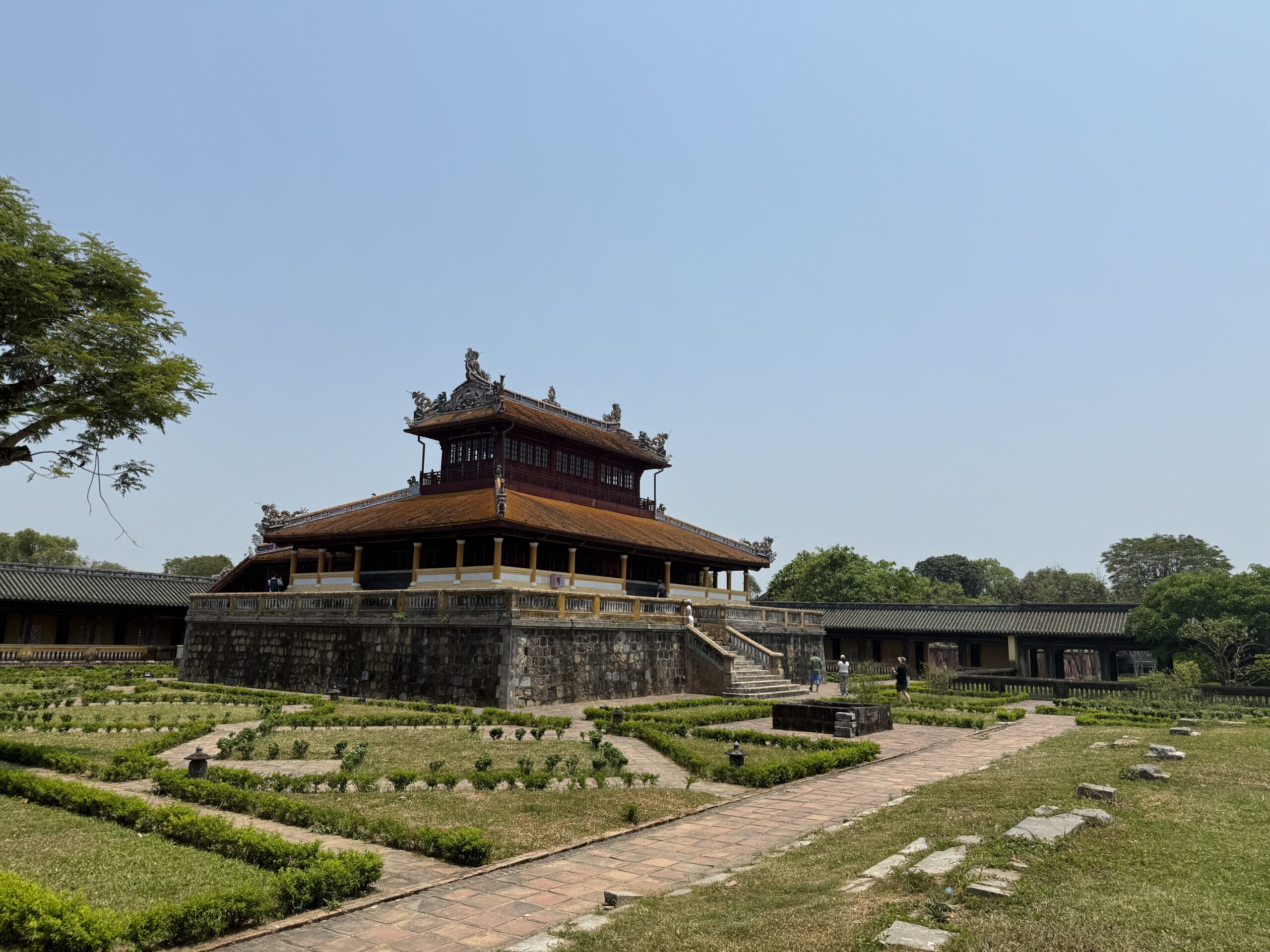
The Imperial City is where you really feel the scale of Huế. It’s much larger than it looks in photos, and you can easily spend two or three hours just walking around. Built in the early 19th century under Emperor Gia Long, it served as the political and ceremonial center of the Nguyễn Dynasty. Parts of it are beautifully restored, while others still show visible damage from past wars, which actually adds to the experience. You’re not walking through something perfectly preserved, but through layers of history. One thing to keep in mind is the heat. There isn’t much shade in certain areas, and the humidity can be intense, especially around midday, so going early and bringing water makes a big difference.
Khải Định Tomb feels completely different. It’s smaller, but far more detailed and visually striking. The European influence is obvious right away, with darker tones, concrete structures, and heavy decoration. Built in the early 20th century, it reflects the emperor’s connection to French culture, which is why it stands out so much compared to other sites in Huế. You’ll need to climb quite a few steps to reach it, but once you’re inside, it’s absolutely worth it. The interior is covered in intricate mosaics made from tiny pieces of glass and porcelain, all placed by hand. It’s one of those places that looks even better in person than in photos, and for me, it was easily the highlight of the day.
Tự Đức Tomb, on the other hand, feels much more relaxed and natural. Surrounded by trees, lakes, and open space, it has a completely different atmosphere. It was built in the mid-19th century and was used by Emperor Tự Đức not just as a tomb, but as a retreat during his lifetime. He would come here to relax, write poetry, and escape the pressure of the royal court. Walking through it feels more like being in a park than a historical site. It’s not as visually intense as Khải Định, but it’s calm and enjoyable in a different way. Interestingly, despite all this, Tự Đức was not actually buried here. His real burial site was kept secret to avoid grave robbers.

In reality, that’s about as much as you can comfortably fit into one day. Three locations already make for a full schedule. Once you factor in the travel time from Da Nang, there isn’t much room left unless you start rushing, and that usually takes away from the experience.
A day trip to Huế is definitely doable, but it’s tight. You have to choose carefully, move efficiently, and accept that you’re only seeing a small part of what the city has to offer. And that’s exactly why the next question becomes important.
Is a Huế Day Trip from Da Nang Worth It?
Was the day rushed? Not really. We didn’t feel like we were constantly running from one place to another. We had time for a proper Huế-style lunch, took breaks when we needed, and even stopped at a small café on the way back over the Hai Van Pass. It felt like a full day, but still enjoyable.
That said, it is a long day. You’re looking at around six hours of travel in total, and that changes the experience more than people expect. A big part of your energy goes into getting there and back, not just exploring Hue itself.
Was it worth it? I’d say yes. Not just because of Huế, but because of the journey. Driving through smaller towns, seeing parts of Vietnam that feel less touched by tourism, and watching the landscape slowly change as you head north adds a lot to the trip. It’s something you simply don’t get by staying in Da Nang.
But if I’m being completely honest, one thing became very clear after the trip. If I did it again, I would stay overnight.
Huế has more depth than what you can experience in a single day. The food alone deserves more time, and the overall atmosphere feels very different when you’re not rushing. We even noticed it with where we ate. We ended up in a more touristy area near the walking street, and you can clearly feel the difference compared to smaller local spots.

That’s the part you miss on a day trip.
So here’s the real takeaway. If you’re based in Da Nang, then yes, Huế is absolutely worth seeing at least once. It’s one of the most historically important places in the country and offers something very different from the beach lifestyle.
But doing it in one day is not ideal.
If you have the time, the best way to do it is simple. Take the train, stay one night, explore at a slower pace, and come back the next day. That’s when Huế really starts to make sense.
If you’re short on time or not a fan of long travel days, you can skip it without feeling like you missed something essential. But if you’re into history, architecture, and want to see a different side of Vietnam, it’s a very solid trip.
Just don’t expect to fully understand Huế in a few hours. It’s one of those places that rewards you the longer you stay.